
Foot exercises: gentle practice for strength, mobility and balance
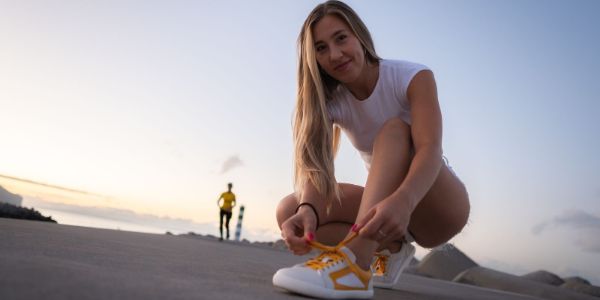
Foot exercises can help you practise toe movement, muscle control and balance. They are not, however, a universal treatment for flat feet, heel pain or bunions. The causes of symptoms vary and cannot automatically be attributed to weak muscles. Wearing barefoot shoes does not mean that everyone needs the same training either.
The following examples draw on NHS and AAOS materials. They provide guidance for adults who can perform the movements safely; they are not an individual rehabilitation plan. After an injury or surgery, with persistent pain, or if you are unsure whether the exercises are suitable, first consult a doctor or physiotherapist. AAOS explicitly recommends professional guidance for its rehabilitation programme.
Stop the exercise if you experience pain, cramp or loss of stability. Cramp is not a necessary sign of effective training. Seek professional advice for recurring symptoms, burning, tingling or reduced sensation. If you have diabetes, neuropathy or broken skin, agree suitable exercises and foot protection with your care team; NIDDK recommends appropriate shoes with socks even at home, rather than walking barefoot.
1. Short foot: activating the arch without curling the toes
The short-foot exercise, also called doming, teaches gentle activation of the arch. It is not gripping the surface with your toe tips or picking up objects.
- Sit on a stable chair and place your foot on a firm surface. Keep the heel and the front of the foot in contact with the surface.
- Try gently activating and lifting the arch without curling your toes. Keep the toes long and relaxed; do not try to “rake” the ground with them.
- Briefly hold the light tension, then relax. If your toes curl or cramp develops, reduce the effort and rest. If you are unsure, ask for a demonstration.
Start with a few calm attempts according to comfort, rather than a compulsory set for everyone. Picking up objects with the toes is a different exercise and should not be confused with activating the arch without curling the toes. Choose children's exercises according to age and with appropriate supervision; small objects are not a universal exercise aid.
2. Toe yoga: moving the toes independently
While seated, rest your foot comfortably on the floor. The aim is to practise controlled movement, not to force a large range.
- The big toe and the other toes: try lifting the big toe while keeping the others on the surface. Then lower the big toe and try lifting the other toes. If needed, gently hold them with your hand, without pulling through pain.
- Spreading the toes: try moving them slightly apart, then relax. Do not force the big toe into a position that causes pressure or pain.
Being unable to separate the movements at first does not, by itself, establish a diagnosis. Toe separators are not essential for this practice and do not replace an assessment of a painful joint.
3. Heel raises and gentle calf stretches
- Supported heel raises: on a flat, firm floor, hold a stable chair or worktop. Slowly lift both heels only to a comfortable height, then lower them with control. A beginner does not need single-leg raises, a step or a towel under the toes.
- A gentle calf stretch: facing a wall, place one foot in front of the other. Keep the back heel on the floor, bend the front knee slightly and move only until you feel a comfortable stretch in the calf. Do not bounce into the end of the range, and stop if it hurts.
Adapt the range, number of repetitions and any hold to your abilities or rehabilitation plan. Stretching is not compulsory after every barefoot walk, and a heel raise is not a test that confirms readiness for barefoot shoes. If your Achilles tendon is painful, seek an individual recommendation about suitable loading.
4. Foot massage and mobility
- Gentle rolling while seated: sitting on a stable chair, you can gently roll your foot over a tennis ball. Keep the pressure light; do not press into a painful spot or use hard protrusions as a test of tolerance.
- Moving the toes by hand: sit comfortably, support your foot and gently bend and straighten the toes within a pain-free range. You do not need to push your fingers between them. Move slowly, without levering the joints.
These approaches are for gentle movement and relaxation. They do not replace an assessment of pain or treatment for a big-toe deformity. Burning or numbness is not a reason to massage harder. With a wound, inflamed skin or reduced sensation, do not try these approaches without professional agreement.
5. Supported balance and mini-squats
- Standing on one leg: stay beside firm support, with your eyes open and the floor level and clear of obstacles. With your hands on the support, briefly lift one foot, then calmly place it back down. If you feel unsteady, keep both feet on the floor and seek advice on a suitable starting point. This is not an endurance competition or a diagnosis based on 30 seconds.
- A mini-squat: hold firm support, with your feet roughly hip-width apart. Slowly bend your knees only as far as feels comfortable, keeping them facing forwards, then calmly straighten up. Deep squats, rocking at the end of the range or circling the knees are not necessary.
Beginners do not need to close their eyes or add an unstable surface. Comfortable, securely fitting shoes may be suitable for these exercises; you do not have to exercise barefoot. Increase the difficulty only once you can manage safely, with professional guidance if needed.
Regular practice and appropriate loading make more sense than chasing repetitions through pain. These exercises do not promise to correct foot shape or prevent knee or back pain. If you use prescribed devices, you will find useful context in our article on barefoot shoes and orthotic insoles; do not change your wearing schedule on your own.
When choosing everyday footwear, you can explore ANTAL barefoot sneakers. Assess the dimensions and comfort of the particular model separately; a shoe does not replace individually recommended exercises or treatment.
Sources: NHS Joint Health Hub — toe movement and doming; AAOS — foot and ankle conditioning; NHS — heel raises and mini-squats; NHS — balance with support; NIDDK — protecting your feet with diabetes.